Dirty Eggs and Egg Eating – How to stop it
Egg-eating and dirty eggs are sone of the most frustrating problems backyard chicken keepers face. Once egg eating starts, it can spread through the flock quickly. A lot of the advice floating around is based on myths, old wives’ tales, and assumptions rather than what actually happens in the coop.
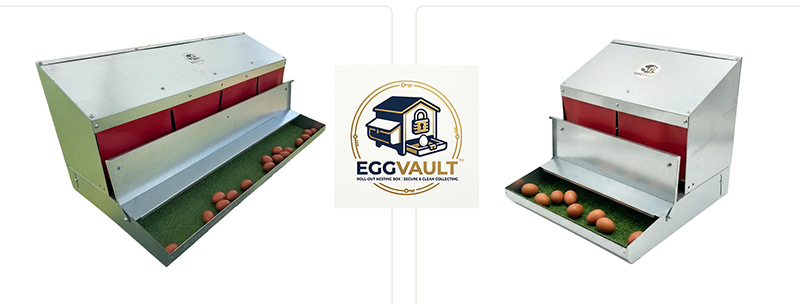
The single best way to prevent dirty eggs and egg-eating in the first place is to use a true roll-out nesting box. One of the strongest options currently available is the new Egg Vault. It features the longest collection tray on the market. With many other roll-out designs, determined hens can still stretch into the tray and reach the eggs. The Egg Vault’s extended tray keeps the eggs completely out of reach and fully protected, so the birds never get the chance to start the habit.
Click the Picture to see the new website
Best Roll Out Nesting Box Video
Dirty Eggs – Why they’re bad…
The Problem with Dirty Eggs
A major issue backyard keepers face is dirty eggs. When an egg sits in a traditional nesting box, it is constantly exposed to droppings and bacteria. While you can certainly wash a dirty egg, doing so strips away its natural, protective bloom. Once that bloom is washed off, the egg can no longer sit safely on your kitchen counter—it must go straight into the refrigerator. This creates a frustrating management problem, as you suddenly have to separate and track your washed, refrigerated eggs differently from your unwashed, counter-safe ones. This is exactly why the new roll-out nesting box design is so important. By immediately rolling the egg away from the chicken and safely out of the droppings area, it prevents 95% to 99% of dirty eggs in the first place, keeping your harvest clean, intact, and ready for the counter.
The Science Behind Egg Eating
1. It is Opportunistic (Exploratory Pecking)
Egg-eating almost always begins as an accident. According to poultry science, when an egg cracks, the exposed interior triggers a chicken’s natural “exploratory pecking” instinct. They taste it, realize it is a high-reward food source, and a bad habit is instantly formed. It is a learned behavior, not an instinctual biological drive.
2. The “Frenzy” is Driven by Social Learning
The flock-wide frenzy is a scientifically studied phenomenon known as social facilitation. Chickens are highly visual learners and hardwired to eat together. When one hen discovers a food source (like a broken egg or a caught mouse) and begins pecking, it acts as a visual cue that instantly triggers a mimicking feeding response in the rest of the flock.
3. The Nutritional Misconception
While a calcium deficiency might cause thin-shelled eggs (making accidental breakage more likely), the act of eating the egg is not a calculated effort by the hen to fix her calcium or protein levels. It’s simply that the broken egg was available, she tasted it, and took advantage of the opportunity.
Myths about egg eating
Myth: Chickens peck at their eggs to check whether the shells are firm enough
Why it’s not true: There is no evidence that hens deliberately test shell strength or quality this way. Pecking that leads to damage or eating almost always starts from curiosity, accidental contact (stepping on an egg, jostling in the nest, or investigating a thin or soft shell), or the learned discovery that the contents taste good. Attributing purposeful “quality control” to the birds is an anthropomorphic explanation that doesn’t match observed behavior.
Myth: Chickens naturally eat their own eggs
Why it’s not true: Intact eggs are not a normal target. The behavior almost always begins by accident when a broken or thin-shelled egg is investigated, the contents prove tasty, and the habit becomes learned (and spreads socially through the flock). Chickens will clean up shells after chicks hatch, but that is very different from targeting whole eggs.
Myth: Calcium deficiency is the main reason chickens eat eggs
Why it’s not true: This is one of the most repeated assumptions. Low calcium can contribute to thinner shells that break more easily and start the cycle, but many eaten eggs show mostly intact shells with just a peck hole — the birds go for the contents, not primarily the shell. Accidental discovery plus management factors (overcrowding, infrequent collection, boredom) play a much bigger role than pure calcium shortage.
Myth: Feeding eggs or eggshells to chickens will make them start eating their own eggs
Why it’s not true: This is classic folklore. Properly prepared cooked eggs or thoroughly dried and crushed eggshells do not trigger nest-box egg eating. The habit starts from raw broken eggs left accessible in the nest, not from deliberately offered cooked eggs or processed shells. Many experienced keepers feed both without any problems.
Myth: Egg-eating is true cannibalism or “eating their babies”
Why it’s not true: Most backyard eggs are unfertilized. Even fertilized ones are not live young in the mammalian sense. Chickens are opportunistic omnivores. Feeding cooked eggs is a normal, nutrient-dense practice for many keepers and has nothing to do with cannibalism.
Myth: Once a hen starts eating eggs, the habit is permanent and the only solution is to cull her
Why it’s not true: Prevention is always easier than cure, and established cases can be stubborn. However, early intervention — frequent egg collection, better nesting setup, enrichment, diet adjustments, dummy eggs, or temporary isolation of the culprit — can break or limit the behavior before it spreads widely through the flock.
Myth: Filling eggs with mustard, soap, hot sauce, or similar will reliably stop egg-eaters
Why it’s not true: Results are mixed at best. Some hens dislike the bitter taste; others ignore it or keep going. This old method does not address the real issues of access to eggs, nesting conditions, or underlying management problems.
The Real Picture
Egg-eating is almost always a learned opportunistic behavior that begins with accidental breakage, not an innate drive or a simple single-cause nutritional problem. Good nesting conditions, strong shells from balanced nutrition, soft deep bedding, dark or roll-away nest boxes, and prompt egg collection remain the most effective ways to prevent it.
Catch it early, fix the management factors, and you have a much better chance of stopping it before it becomes a flock-wide habit. Using a properly designed roll-out system like the Egg Vault removes the opportunity entirely by keeping the eggs safely out of reach the moment they are laid.